

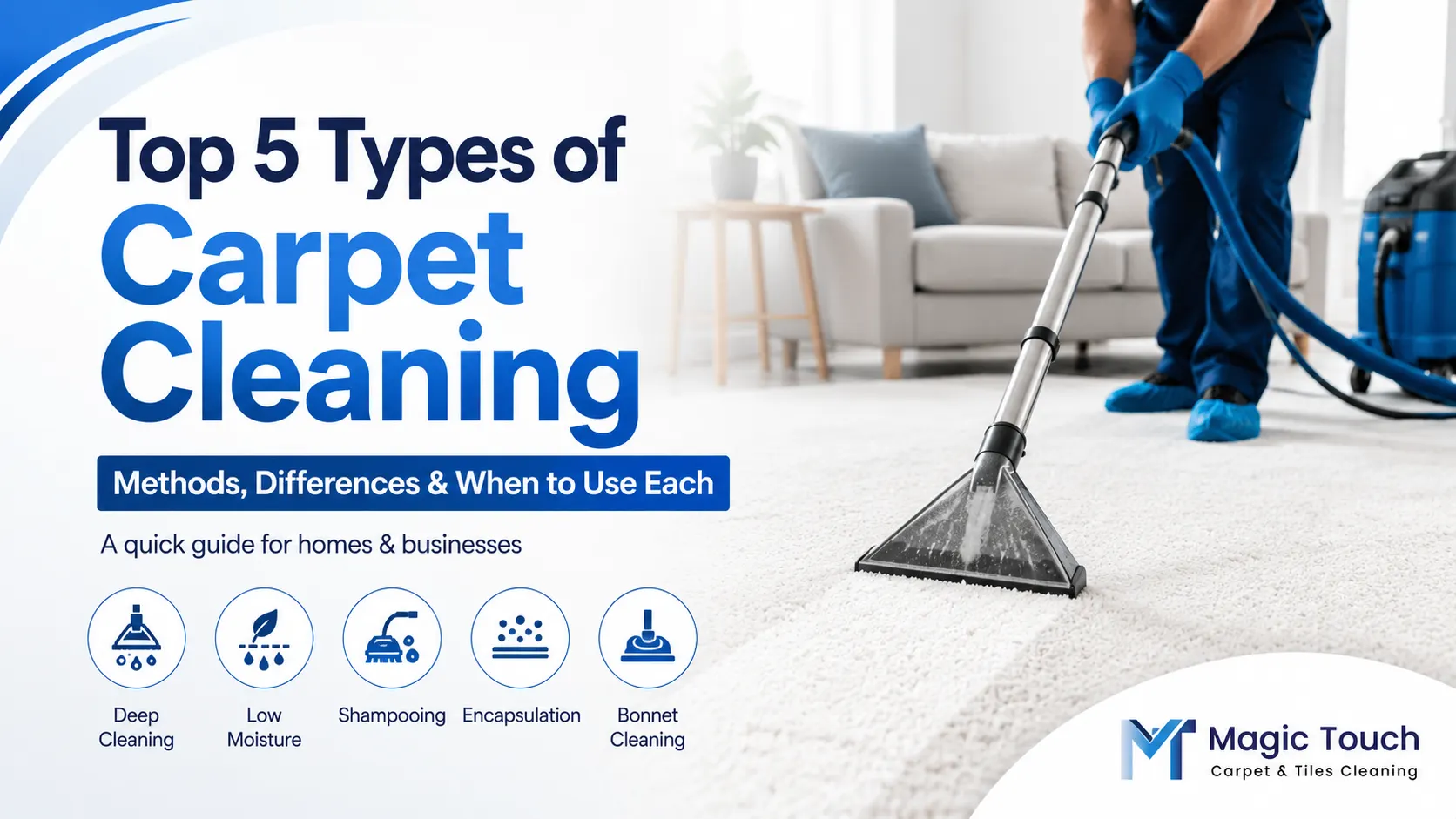
Carpet cleaning methods differ in water usage, soil removal depth, drying time, and long term fiber impact, which directly affects indoor air quality, maintenance costs, and carpet lifespan. The global carpet and rug market exceeds 50 billion dollars annually, and industry data from the
Carpet and Rug Institute shows that accumulated soil can reduce carpet life by up to 50 percent due to abrasive wear under foot traffic. Indoor environmental studies also confirm that carpets trap allergens such as dust mites, pet dander, and pollen, making cleaning method selection relevant for hygiene control.
Choosing the correct technique supports healthier indoor environments and preserves flooring investments.
This guide explains the five main types of carpet cleaning methods:
- Hot Water Extraction
- Dry Carpet Cleaning
- Carpet Shampooing
- Encapsulation Carpet Cleaning
- Bonnet Cleaning
1. Hot Water Extraction (Steam Carpet Cleaning)

Hot water extraction, commonly known as steam carpet cleaning, is a deep cleaning method that uses heated water and strong suction to remove dirt, allergens, and residues from deep within carpet fibers.
It is widely considered the most thorough carpet cleaning technique available today.
Major carpet manufacturers such as Shaw Industries and Mohawk Industries recommend this method to maintain carpet warranties because it removes embedded soil without harming synthetic fibers when performed correctly.
Industry bodies also recognize it as the preferred restorative cleaning method for residential and commercial carpets.
Hot water extraction focuses on flushing out contaminants rather than just cleaning the surface. That is why it is often chosen when hygiene, allergen control, and long term carpet health matter.
How Hot Water Extraction Works
Hot water extraction works by injecting heated water, usually between 65°C and 95°C, into the carpet under controlled pressure. The hot solution penetrates deep into the pile and backing, loosening oils, dust, bacteria, and trapped debris.
Immediately after injection, powerful vacuum suction removes the water along with dissolved soil.
Professional truck mounted systems generate higher water temperature and stronger suction than most portable units, which improves soil removal and shortens drying time.
The entire process typically follows this sequence:
| Step | What Happens | Why It Matters |
| Pre vacuuming | Dry soil is removed first | Prevents mud formation during wet cleaning |
| Pre treatment | Cleaning solution is applied to heavy soil areas | Breaks down oils and stains |
| Hot water injection | Heated water penetrates deep into fibers | Loosens embedded contaminants |
| High powered extraction | Water and soil are removed immediately | Reduces residue and moisture retention |
| Drying phase | Airflow supports evaporation | Prevents mold risk |
The Carpet and Rug Institute explains that properly performed hot water extraction removes a significant portion of common indoor allergens.
Environmental health studies show measurable reduction in dust mite allergen levels after deep extraction compared to surface cleaning methods.
This method does not sterilize the carpet completely, but it significantly lowers the level of bacteria, pet dander, and pollen trapped in fibers.
When to Use Steam Cleaning
Steam cleaning is most effective when carpets are heavily soiled, stained, or have not been professionally cleaned for a long period.
It is also recommended for households with pets, young children, or allergy sensitive individuals because it targets deep contamination.
Hotels, healthcare facilities, and commercial offices use hot water extraction as part of scheduled restorative cleaning programs.
The Institute of Inspection Cleaning and Restoration Certification recommends professional deep cleaning at least once every 12 months for most homes. High traffic commercial areas often require cleaning two to four times per year depending on usage levels.
You should consider hot water extraction when:
- Visible traffic lanes appear dark or matted
- Odors remain after vacuuming
- Allergy symptoms increase indoors
- The carpet feels stiff due to soil buildup
- Warranty requirements specify extraction cleaning
Deep extraction helps restore fiber texture and color by removing abrasive soil particles that gradually wear down carpet material.
2. Dry Carpet Cleaning (Low Moisture Cleaning)

Dry carpet cleaning, also known as low moisture carpet cleaning, is a method that uses minimal water and specialized cleaning compounds to remove dirt from carpet fibers.
It focuses on fast drying time and reduced operational downtime rather than deep flushing of the carpet backing.
This method has become popular in commercial environments where closing a building for long drying periods is not practical.
Offices, retail stores, hotels, and conference centers often rely on low moisture systems for regular maintenance cleaning.
Dry cleaning is designed to improve appearance and manage routine soil levels. It does not aim to replace deep extraction cleaning but rather to support ongoing carpet care between major cleaning cycles.
How Dry Carpet Cleaning Works
Dry carpet cleaning works by applying a cleaning compound or polymer solution to the carpet surface. Mechanical agitation from rotating brushes or counter rotating pads works the product into the fibers.
The cleaning material binds to soil particles. After a short dwell time, the compound is removed through vacuuming, taking attached dirt and debris with it.
Modern low moisture systems often use encapsulation technology. In this process, cleaning polymers surround soil particles and form tiny crystals as they dry. Regular vacuuming then removes these crystallized particles from the carpet.
The general process typically follows this sequence:
| Step | What Happens | Why It Matters |
| Pre vacuuming | Loose debris is removed first | Prevents dry soil from interfering with cleaning |
| Application of compound or polymer | Cleaning agent is distributed evenly | Targets surface and moderate soil |
| Mechanical agitation | Brushes work product into fibers | Loosens and suspends dirt |
| Short dwell time | Product binds to soil | Improves removal efficiency |
| Vacuum removal | Soil and compound are extracted | Leaves carpet clean and dry |
Because water usage is very low, carpets usually dry within 30 minutes to 2 hours. This rapid drying time makes dry carpet cleaning suitable for buildings that must remain open during cleaning.
Industry maintenance studies show that consistent low moisture cleaning reduces visible traffic lanes and helps maintain carpet appearance between deep cleaning cycles.
When to Use Dry Carpet Cleaning
Dry carpet cleaning works best for routine maintenance in commercial buildings with steady foot traffic.
It is especially useful in environments where moisture control is important, such as data centers, libraries, and office spaces with sensitive equipment.
It is effective for light to moderate soil levels. For carpets with heavy staining, grease buildup, or deep embedded dirt, hot water extraction generally provides better results.
Facilities management research indicates that preventive maintenance cleaning reduces long term carpet replacement costs. Regular removal of surface soil prevents abrasive particles from wearing down fibers.
You should consider dry carpet cleaning when:
- Immediate carpet use is required
- Business operations cannot pause for long drying times
- Soil levels are light to moderate
- The carpet is part of a scheduled maintenance program
- Moisture exposure must be minimized
Low moisture cleaning supports appearance management and operational efficiency in busy environments.
3. Carpet Shampooing

Carpet shampooing is a traditional carpet cleaning method that uses a foaming detergent and mechanical brushing to scrub dirt from the surface of carpet fibers. It focuses more on appearance improvement than deep extraction.
Before modern hot water extraction systems became common, shampooing was widely used in hotels, offices, and public buildings.
Today, it still appears in some commercial maintenance programs where quick visual refresh is the main objective.
Carpet shampooing relies heavily on agitation rather than deep rinsing. That difference defines both its strengths and its limitations in modern carpet care.
How Carpet Shampooing Works
Carpet shampooing works by applying a foamy cleaning solution to the carpet and agitating it with a rotating brush machine. The brush loosens dirt from the upper layer of the carpet pile.
The foam surrounds soil particles and lifts them toward the surface. After the carpet dries, the residue containing dirt is removed through vacuuming.
The process generally follows these steps:
| Step | What Happens | Why It Matters |
| Pre vacuuming | Loose debris is removed | Prevents heavy mud formation |
| Foam application | Detergent is spread evenly | Breaks down surface oils |
| Mechanical scrubbing | Rotating brush agitates fibers | Lifts visible soil |
| Drying phase | Foam dries into residue | Prepares dirt for removal |
| Post vacuuming | Dried residue is vacuumed out | Removes suspended soil |
Earlier shampoo formulas often left sticky detergent residue. That residue attracted dirt quickly, which caused carpets to re soil faster.
Modern shampoo solutions are designed to reduce residue, but improper rinsing or overuse can still leave buildup behind. Because shampooing does not fully flush out the carpet backing, it mainly cleans the upper third of the pile.
This makes it effective for surface soil but less powerful for deep contamination.
When to Use Carpet Shampooing
Carpet shampooing is typically used in commercial settings where improving visual appearance is the primary goal. It works well in conference halls, banquet rooms, and event spaces that need surface refresh before or after gatherings.
It may also be used as part of a periodic maintenance schedule in lower traffic environments.
Shampooing is less suitable for delicate fibers such as wool. Aggressive brushing can distort or fray natural fibers. It is also not ideal when allergen reduction or deep sanitation is required.
You may consider carpet shampooing when:
- The carpet shows dullness but not deep staining
- Surface soil is visible in moderate traffic areas
- Budget limitations require a lower cost option
- Immediate deep sanitization is not necessary
For heavy soil buildup, pet contamination, or odor problems, hot water extraction remains the more effective choice.
4. Encapsulation Carpet Cleaning

Encapsulation carpet cleaning is a low moisture method that uses advanced polymer chemistry to trap dirt particles in microscopic crystals, which are later removed through vacuuming. It is widely used in commercial maintenance programs because it delivers fast drying, minimal disruption, and consistent visual improvement.
Facility management studies show that encapsulation cleaning can reduce carpet downtime by up to 60 to 70 percent compared to traditional hot water extraction. That advantage makes it popular in offices, schools, retail stores, airports, and conference centers where daily operations must continue without interruption.
Encapsulation is often positioned between deep extraction and routine vacuuming. It does not aim to flush the carpet with water. Instead, it focuses on controlled moisture cleaning that improves appearance and manages soil buildup over time.
How Encapsulation Carpet Cleaning Works
Encapsulation cleaning begins with the application of a specialized cleaning solution that contains synthetic polymers. These polymers are designed to attach to soil particles when agitated into the carpet fibers.
A cylindrical brush machine or rotary scrubber works the solution evenly into the pile. The mechanical action loosens dirt from the fiber surface and distributes the polymer chemistry across the carpet.
As the carpet dries, the polymer forms small crystals around the loosened soil. These crystals are dry and brittle. Routine vacuuming then removes the crystallized dirt from the carpet.
The process typically follows this sequence:
| Step | What Happens | Why It Matters |
| Pre vacuuming | Loose dry soil is removed | Improves cleaning efficiency |
| Application of polymer solution | Cleaning chemistry is evenly distributed | Prepares soil for encapsulation |
| Mechanical agitation | Brushes lift and separate dirt from fibers | Enhances contact between soil and polymer |
| Crystallization during drying | Soil is trapped in dry crystals | Prevents sticky residue |
| Post vacuuming | Crystals are removed from carpet | Leaves fibers clean and dry |
Cleaning technology research shows that encapsulation chemistry reduces rapid re soiling because it does not leave detergent residue behind.
Older shampoo methods often left sticky surfactants that attracted new dirt. Encapsulation polymers dry into non tacky crystals, which helps carpets stay cleaner longer.
The low moisture nature of encapsulation allows carpets to dry within one to two hours in most indoor environments. Faster drying reduces slip hazards and lowers the risk of microbial growth, especially in humid climates.
When to Use Encapsulation Carpet Cleaning
Encapsulation works best as a maintenance method for commercial low pile carpets. It is particularly effective in high traffic areas where appearance matters but deep flushing is not immediately required.
Corporate offices, schools, airports, and hospitality spaces often use encapsulation on a monthly or quarterly schedule. It keeps carpets visually clean between periodic deep extraction services.
Encapsulation is not the first choice for heavily soiled residential carpets or severe staining. In those situations, hot water extraction provides better penetration and soil removal.
Many commercial carpet maintenance programs follow a hybrid model. They schedule hot water extraction once or twice per year and use encapsulation for interim cleaning.
This combination balances deep sanitation with operational efficiency and cost control.
You should consider encapsulation when:
- The carpet requires quick drying
- Business downtime must be minimized
- Soil levels are moderate rather than severe
- Maintenance cleaning is performed regularly
- The carpet is low pile and synthetic
5. Bonnet Cleaning

Bonnet cleaning is a low moisture surface cleaning method that focuses on improving the appearance of carpet in high traffic areas. It uses a rotating absorbent pad to lift soil from the top layer of the carpet pile rather than cleaning deep into the backing.
This method is widely used in commercial environments where visual cleanliness matters and downtime must remain minimal. Hotels, convention centers, banquet halls, and office buildings often rely on bonnet cleaning between major events or guest stays.
Bonnet cleaning is designed for maintenance, not deep restoration. Understanding its purpose helps prevent misuse and long term carpet damage.
How Bonnet Cleaning Works
Bonnet cleaning begins with thorough pre vacuuming to remove loose debris. This step prevents dry soil from turning into muddy residue during the cleaning process.
A floor machine fitted with an absorbent pad, known as a bonnet, is then used. The pad is lightly moistened with a cleaning solution and rotated across the carpet surface.
As the bonnet spins, it transfers soil from the carpet fibers onto the pad through absorption and gentle friction. The method primarily cleans the upper third of the carpet pile.
The process generally follows these stages:
| Step | What Happens | Why It Matters |
| Pre vacuuming | Loose dirt and debris are removed | Prevents surface smearing |
| Solution application | Cleaning solution is lightly sprayed | Loosens surface soil |
| Rotary bonnet action | Absorbent pad rotates over carpet | Lifts dirt from top fibers |
| Pad replacement | Soiled pads are changed frequently | Maintains cleaning effectiveness |
| Air drying | Minimal moisture evaporates quickly | Allows fast reuse of space |
Pads must be cleaned or replaced frequently because they saturate with soil quickly. If not replaced, they may redistribute dirt across the surface.
Unlike hot water extraction, bonnet cleaning does not flush soil out of the carpet backing. It focuses only on the visible surface layer.
When to Use Bonnet Cleaning
Bonnet cleaning is most appropriate for interim maintenance in commercial settings. It works well when carpets need to look clean quickly but do not require deep sanitation.
Hotels often use bonnet cleaning between guest checkouts to refresh corridors and meeting rooms. Event venues rely on it after conferences or gatherings to remove visible traffic marks.
You should consider bonnet cleaning when:
- Quick drying is essential
- The carpet has light to moderate surface soil
- The priority is visual improvement
- Deep cleaning was recently performed
It is not recommended for heavily soiled carpets or residential spaces requiring allergen removal. Overuse without periodic deep extraction may push fine particles deeper into the carpet backing.
Best Carpet Cleaning Method for Each Carpet Type
The best carpet cleaning method depends on the fiber material, pile structure, and level of foot traffic.
Each carpet type reacts differently to heat, moisture, and mechanical agitation. Choosing the correct method protects fiber strength, preserves appearance, and extends overall lifespan.
Carpet manufacturers design fibers with different tolerances. Synthetic carpets handle heat and water better than natural fibers such as wool. Loop construction behaves differently than cut pile. High traffic areas need more frequent soil removal than low use spaces.

The table below summarizes which cleaning method works best for each carpet type and why.
| Carpet Type | Recommended Cleaning Method | Why It Works Best | Cleaning Frequency |
| Synthetic (Nylon, Polyester, Polypropylene) | Hot Water Extraction | Tolerates heat and moisture well, removes embedded soil effectively | Every 12–18 months |
| Wool | Low Moisture or Controlled Hot Water Extraction | Prevents shrinkage, protects natural fibers | Every 12 months |
| Berber (Loop Pile) | Hot Water Extraction | Removes trapped dirt inside loops without aggressive brushing | Every 12–18 months |
| Commercial Low Pile | Encapsulation + Periodic Extraction | Fast drying for business use, maintains appearance | Monthly maintenance + quarterly deep cleaning |
| High Traffic Zones | Encapsulation + Scheduled Extraction | Frequent soil removal prevents fiber abrasion | Every 3–6 months |
Now let us look at each carpet type more closely so you understand why these methods work best.
Professional Cleaning vs DIY Carpet Cleaning Machines
Choosing between professional carpet cleaning and DIY machines depends on cleaning depth, equipment power, drying time, and long term carpet care. Both options improve appearance, but the results, hygiene level, and fiber protection differ significantly.
Understanding these differences helps you decide whether a quick refresh is enough or a deeper professional service is necessary.

Professional Carpet Cleaning
Professional carpet cleaning delivers deeper soil removal, stronger suction, and better moisture control compared to most consumer machines. Industrial grade equipment penetrates deeper into carpet fibers and extracts more embedded dirt.
Truck mounted hot water extraction systems generate higher water pressure and stronger vacuum power than rental units. This combination removes soil, allergens, and cleaning residues more effectively. The Carpet and Rug Institute consistently recommends professional extraction for maintaining carpet warranties and extending fiber life.
Professional technicians also understand fiber types, pH balance, and stain chemistry. Incorrect solution use can damage carpet backing or leave sticky residue. Trained cleaners adjust temperature, dwell time, and extraction strength based on carpet material.
Drying time is often shorter with professional equipment because stronger suction removes more moisture. Faster drying reduces the risk of mold growth, especially in humid environments.
For homes with pets, children, or allergy concerns, professional cleaning reduces allergen levels more reliably than surface level cleaning. Indoor air quality studies show that deep extraction lowers dust mite and particulate levels when combined with proper vacuuming.
DIY Carpet Cleaning Machines
DIY carpet cleaning machines are smaller portable units available for rent or home use. They provide surface level improvement and can remove light stains when used properly.
These machines operate at lower pressure and suction compared to commercial systems. As a result, they may leave more moisture behind. Excess moisture increases drying time and can lead to odor or microbial growth if carpets remain damp for too long.
DIY cleaning works best for light maintenance, small spills, or refreshing carpets between professional services. It is generally more affordable in the short term, especially for smaller spaces.
However, improper use can cause over wetting or detergent buildup. Residual soap attracts dirt, which leads to faster re soiling. Many homeowners unknowingly use too much cleaning solution, which affects carpet texture and appearance over time.
While rental machines improve visible cleanliness, independent product testing reports show that they remove less embedded soil compared to professional truck mounted extraction systems.
Which Option Makes More Sense Long Term
DIY machines serve as a temporary maintenance tool. Professional cleaning provides deeper restoration and longer-lasting results.
Regular professional extraction extends carpet lifespan by removing abrasive particles that damage fibers under foot traffic. Soil acts like sandpaper inside carpet pile, gradually weakening the structure. Removing that soil preserves appearance and texture.
Cost comparison should consider lifespan value. Replacing carpet is significantly more expensive than scheduling periodic professional cleaning. In many cases, professional maintenance every 12 to 18 months prevents premature wear.
For heavily soiled carpets, pet contamination, persistent odors, or allergy concerns, professional carpet cleaning delivers safer, more consistent results. DIY cleaning fits short term refresh needs, but professional service protects long term investment.
How to Choose the Right Carpet Cleaning Method for Your Home or Business
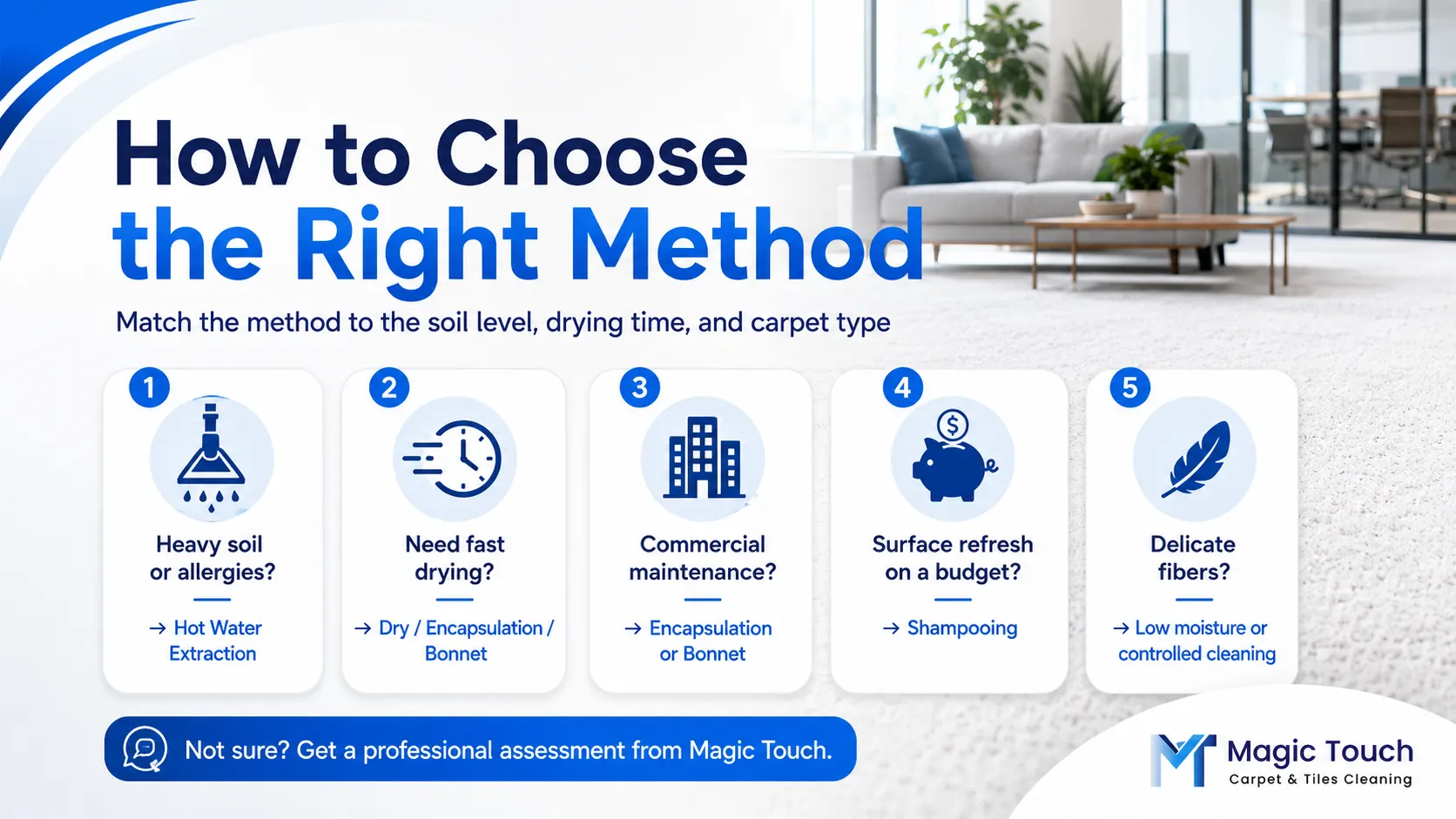
The right carpet cleaning method depends on carpet material, level of soiling, drying time needs, and long term maintenance goals. Deep embedded dirt and allergens require hot water extraction, while routine upkeep in busy spaces often benefits from low moisture or encapsulation cleaning.
Homes with pets, children, or allergy concerns usually need scheduled deep cleaning at least once a year to maintain indoor air quality. Commercial spaces with heavy daily traffic often combine interim low moisture cleaning with periodic deep extraction to prevent fiber wear.
Climate and ventilation also influence the decision. Humid conditions require controlled moisture to reduce mold risk. Following manufacturer cleaning recommendations helps protect carpet warranties and extend lifespan.
Magic Touch Carpet and Tiles Cleaning Company provides professional assessment to match the correct cleaning method to each carpet type. Our trained team uses industry grade equipment to deliver safe, effective, and long lasting results for both homes and businesses.
Conclusion
Carpet cleaning methods differ in purpose, depth, moisture use, and long term impact on fiber condition. Hot water extraction remains the most effective option for deep soil and allergen removal, while encapsulation and dry cleaning support fast maintenance in commercial environments.
Shampooing and bonnet cleaning improve surface appearance but require periodic deep extraction to prevent residue buildup and embedded soil accumulation.
Industry research confirms that regular soil removal reduces fiber abrasion, extends carpet lifespan, and improves indoor air quality. The correct cleaning method depends on carpet material, traffic level, hygiene requirements, and drying time constraints.
A structured maintenance plan that combines interim cleaning with scheduled deep extraction provides the most balanced, cost effective approach for both residential and commercial spaces.
Related Blog: What Is Carpet Cleaning?
