

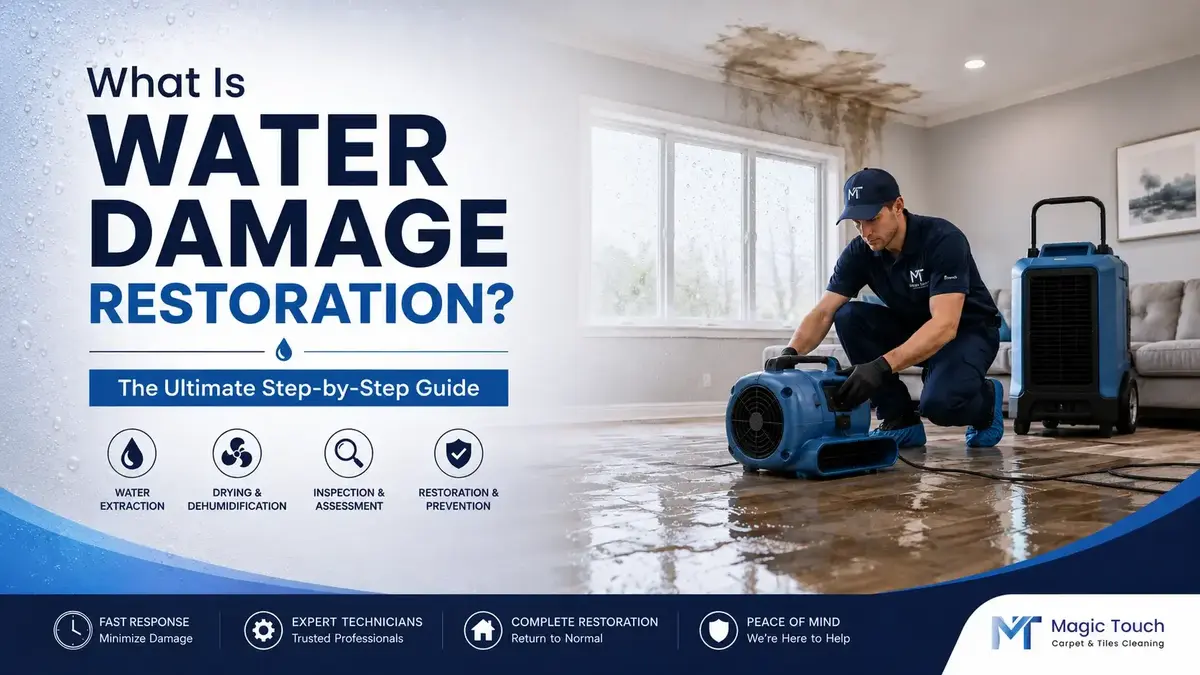
Water damage remains one of the most frequent and costly property insurance claims worldwide, with water and freezing losses accounting for nearly 30 percent of residential claims each year, and severe weather events increasing in frequency across Australia and other regions.
Even small leaks can saturate plasterboard, timber, and insulation within hours, while mould growth may begin within 24 to 48 hours under humid conditions.
Rising rainfall intensity, aging plumbing systems, and higher indoor asset values have made water intrusion a growing structural and financial risk.
Effective water damage restoration reduces long-term structural deterioration, limits mould-related health exposure, and significantly lowers overall repair and insurance costs when addressed early.
In this guide, I will explain what water damage restoration means, what causes water damage, how professionals classify it, and the exact steps used to restore a property.
What Is Water Damage Restoration?
Water damage restoration is the professional process of drying, cleaning, and repairing a home or building after water has entered where it should not be. It aims to remove moisture completely, prevent mould growth, and return the property to its original condition.
Water can enter through burst pipes, leaking roofs, overflowing appliances, blocked drains, or heavy storms. Once water soaks into plasterboard, timber, carpets, and insulation, it spreads fast and becomes difficult to control.
In Australia, water damage is one of the most common insurance claims, particularly after severe weather events and plumbing failures.
Restoration goes beyond mopping up visible water. Professionals locate hidden moisture inside walls, under flooring, and within structural cavities.
They use moisture meters, thermal imaging, air movers, and industrial dehumidifiers to dry materials properly.
The goal is to stabilise the structure quickly, prevent mould within the first 24 to 48 hours, and minimise long-term repair costs.
Common Causes of Water Damage
Water damage usually starts from a small failure that spreads quickly. Most incidents fall into clear patterns. Identifying the source early helps determine how serious the situation is and what type of water damage restoration is needed.

1. Plumbing Failures and Burst Pipes
Plumbing problems remain one of the most common causes of indoor water damage. Split pipes, worn fittings, and leaking flexi hoses can release large volumes of water within minutes.
In Australia, sudden cold snaps in southern states can cause pipes to crack, especially in older homes.
Even a slow drip behind a wall can soak insulation and timber framing. If moisture remains for more than 24 to 48 hours, mould growth becomes a real risk.
2. Roof Leaks and Storm Damage
Roof leaks are common after heavy rain, hail, or strong winds. Damaged tiles, rusted metal sheets, and blocked gutters allow water to enter ceiling cavities.
The Bureau of Meteorology reports that intense rainfall events are increasing in frequency across parts of Australia. Water may first show as ceiling stains, but it often spreads through insulation and wall cavities before becoming visible.
3. Appliance and Hot Water System Failures
Washing machines, dishwashers, and hot water systems can fail without warning. A burst hose or tank rupture may release 50 litres or more in a short time.
Water often spreads across the flooring and into adjoining rooms, especially in multi-level homes.
4. Sewage Backups and Flooding
Blocked drains and stormwater overflows can push contaminated water back into properties. Floodwater from cyclones or flash flooding carries debris and bacteria.
Even shallow floodwater can cause extensive structural damage. Immediate professional drying and sanitising are essential to protect both property and health.
Categories and Classes of Water Damage
Water damage is assessed in two ways: by how contaminated the water is and by how deeply it has soaked into materials. Restoration professionals use these classifications to decide safety precautions, drying methods, and urgency.
Understanding the difference between categories and classes helps property owners in Australia respond faster and more effectively, especially after storms, plumbing failures, or flash flooding.
Water Categories

Water damage categories describe the level of contamination and the potential health risk involved. The higher the category, the greater the risk to people and the more intensive the cleaning process.
- Category 1 water is clean water from sources such as burst supply pipes, rainwater entering through a roof leak, or overflowing sinks without contaminants. It poses minimal health risk at first. However, if left untreated for 24 to 48 hours, bacteria can multiply and change its classification.
- Category 2 water, often called grey water, contains chemicals, microbes, or other contaminants that may cause illness. Common sources include washing machines, dishwashers, and toilet overflows without solid waste. Direct contact is not recommended without protection.
- Category 3 water, known as black water, is highly contaminated and considered hazardous. It includes sewage backups, river flooding, and stormwater mixed with debris. In Australia, flood events often introduce mud, organic matter, and harmful bacteria into homes. Professional protective equipment and full sanitation procedures are essential.
Water does not stay in one category forever. Clean water that sits for more than two days can deteriorate into a higher risk category due to microbial growth.
Classes of Water Damage

Water damage classes describe the extent of absorption and how difficult drying will be. These classes focus on the size of the affected area and how deeply moisture has penetrated structural materials.
- Class 1 involves minimal water absorption. Only a small portion of a room is affected, and materials have absorbed little moisture. Drying is usually quick and straightforward.
- Class 2 affects a larger portion of a room. Moisture may have wicked up walls and saturated carpets or underlay. More equipment is required to restore safe moisture levels.
- Class 3 indicates extensive saturation. Water often comes from overhead sources such as burst ceiling pipes or heavy roof leaks. Walls, insulation, and subflooring may be fully soaked.
- Class 4 involves materials with low permeability such as hardwood flooring, concrete, brick, or plaster. These materials absorb moisture slowly but release it slowly as well. Specialised drying techniques and extended monitoring are required.
Signs You Need Water Damage Restoration
Water damage does not always look dramatic. In many Australian homes, it starts quietly after heavy rain, a leaking pipe, or a blocked gutter.
Early signs are often small but meaningful. Spotting them quickly can prevent major repairs, mould problems, and insurance complications later.

Visible Structural Damage
Visible structural damage is often the first clear warning that moisture has entered building materials. Stains, swelling, or surface distortion usually mean water has travelled deeper than what you see.
Common visible signs include:
- Brown or yellow ceiling stains after storms
- Bubbling or peeling paint on walls
- Sagging plasterboard ceilings
- Warped skirting boards or door frames
- Soft spots under carpet or timber flooring
Timber framing begins to weaken when moisture content remains above 20 percent for extended periods. Australian building research shows prolonged dampness increases the risk of decay fungi and structural rot.
If plasterboard feels soft or crumbly, the internal paper lining has likely absorbed water. That usually means moisture is sitting inside the wall cavity.
Hidden Moisture and Musty Odours
Hidden moisture is often more dangerous than visible damage. You may not see water, but you can smell it.
A musty or earthy odour usually signals microbial growth in damp materials. This smell develops when mould spores feed on organic surfaces such as timber, carpet underlay, or plasterboard paper.
Restoration technicians in Australia commonly find:
- Elevated wall cavity humidity even when surfaces feel dry
- Moisture trapped under tiled bathrooms or laundry areas
- Damp insulation behind external brick veneer walls
Indoor humidity above 60 percent creates ideal conditions for mould growth. In coastal areas like Sydney or Brisbane, naturally higher humidity can make hidden moisture problems worse.
If a room smells damp days after a leak or storm, the area likely has not dried properly.
Warped Flooring or Peeling Paint
Flooring reacts quickly to moisture changes. Timber expands when wet and shrinks unevenly as it dries. This movement causes visible distortion.
Signs to look for include:
- Cupping or lifting floorboards
- Gaps forming between boards
- Laminate flooring bubbling at the edges
- Tiles sounding hollow due to subfloor moisture
Paint and wall finishes also react to trapped moisture. When water builds up behind plasterboard, paint may blister or peel away. These surface changes often indicate deeper saturation inside the wall.
In Australian homes with slab foundations, moisture can also wick upward from the concrete if waterproofing fails.
Mould Spots and Humidity Changes
Mould growth is one of the clearest indicators that water damage has not been fully addressed. It often appears as small black, green, or grey spots on ceilings, walls, or window frames.
The Centers for Disease Control and Prevention confirms that mould can begin growing within 24 to 48 hours after water exposure. In humid climates across northern Australia, growth may occur even faster if ventilation is poor.
Other warning signs include:
- Condensation forming on windows in dry weather
- Sudden increases in indoor humidity readings
- Allergy symptoms that worsen indoors
- Dark staining around air vents or ceiling corners
Even small patches of mould usually indicate an ongoing moisture issue. Cleaning the surface alone does not solve the underlying cause.
The Complete Water Damage Restoration Process Step by Step Breakdown
Water damage restoration follows a clear and controlled sequence. The purpose is to remove water, dry all materials to safe moisture levels, prevent microbial growth, and restore structural integrity.
Each stage connects to the next. Skipping one step often leads to hidden moisture, mold growth, or structural failure later.

Below is how professional restoration teams handle water intrusion from start to finish.
1. Emergency Response and Inspection
Emergency response starts immediately after the loss is reported. The first priority is to stop the source of water and stabilise the property.
Technicians identify whether the water is still flowing, such as from a burst pipe, or if it is residual standing water.
Shutting off supply lines or isolating affected systems prevents continued damage. Quick action within the first 24 hours significantly reduces secondary deterioration, including swelling, warping, and microbial growth.
An initial inspection follows. Professionals determine:
- Source of water
- Category of water contamination
- Affected structural areas
- Immediate safety risks such as electrical hazards
This stage sets the foundation for the entire restoration plan.
2. Damage Assessment and Moisture Mapping
Damage assessment answers one critical question: how far has the water traveled?
Water rarely stays in one place. It spreads behind walls, under flooring, and inside insulation. Surface drying alone does not solve the problem.
Technicians use:
- Infrared thermal imaging cameras to detect hidden moisture
- Pin and non-penetrating moisture meters to measure material content
- Hygrometers to measure ambient humidity
Wood framing is typically considered dry below 15 percent moisture content. Drywall readings are expected to return close to normal baseline levels before reconstruction begins.
Moisture mapping creates a documented layout of all affected zones. This prevents missed wet pockets that later cause mold growth or odor problems.
3. Water Extraction and Removal
Water extraction is the most critical early step. The faster standing water is removed, the less damage occurs.
Commercial-grade extractors and truck-mounted pumps can remove large volumes of water rapidly. Extraction reduces saturation time, which directly lowers structural weakening and microbial risk.
Building science research consistently shows that prolonged saturation increases the probability of irreversible material damage. Materials such as drywall and particle board begin degrading quickly when exposed for extended periods.
Effective extraction:
- Reduces drying time
- Minimizes material replacement
- Limits mold risk
Without thorough extraction, drying equipment must work significantly harder.
4. Drying and Dehumidification
Drying removes moisture trapped inside structural materials. Dehumidification removes excess water vapor from the air.
This stage is controlled and monitored, not guesswork.
Air movers create directed airflow across wet surfaces to accelerate evaporation. Dehumidifiers pull moisture from the air and condense it into collection tanks or drainage systems.
Indoor humidity is typically reduced to between 30 and 50 percent to support safe drying conditions.
Commercial dehumidifiers can remove over 100 pints of water per day under optimal conditions. However, drying timelines vary depending on:
- Class of water damage
- Material density
- Temperature and airflow
- Extent of saturation
Moderate structural drying usually takes three to five days. Severe cases may require longer periods with continuous moisture monitoring.
Daily moisture readings confirm progress and ensure materials return to acceptable levels.
5. Cleaning, Sanitising, and Odor Removal
Water intrusion often leaves behind contamination, especially in gray or black water situations.
Cleaning removes debris and residue. Sanitising reduces bacterial and microbial risks. The Environmental Protection Agency advises disinfecting areas affected by contaminated water to prevent illness.
Non-porous materials such as tile and metal are cleaned and treated. Porous materials like insulation and certain carpeting may require removal if contamination is severe.
Odor removal becomes necessary when water exposure produces persistent smells. Professionals use:
- HEPA air scrubbers to capture airborne particles
- Activated carbon filtration to neutralize odor molecules
- Thermal fogging to penetrate affected materials
These techniques improve indoor air quality and eliminate lingering odors caused by microbial activity.
6. Mold Remediation If Required
Mold remediation becomes necessary when visible growth appears or moisture remained elevated for more than 24 to 48 hours.
Mold spreads through microscopic spores that travel through air currents. The World Health Organization associates prolonged damp indoor conditions with increased respiratory symptoms and allergic reactions.
Remediation involves:
- Containment barriers to isolate affected areas
- Negative air pressure systems to prevent spore spread
- HEPA filtration to capture airborne particles
- Removal or cleaning of affected materials
Proper remediation stops cross contamination and restores safe indoor air quality.
7. Structural Repair and Reconstruction
Once drying and cleaning are complete, reconstruction begins.
This phase restores the property to its pre-loss condition. Depending on severity, reconstruction may involve:
- Replacing drywall and insulation
- Reinstalling flooring
- Repairing framing
- Painting and finishing
In severe flood situations, entire wall sections or subfloors may require replacement. Reconstruction ensures both structural integrity and visual restoration.
8. Final Inspection and Documentation
Final inspection verifies that drying goals are achieved and contamination has been addressed.
Technicians recheck moisture levels to confirm stability. Documentation includes equipment logs, moisture readings, and repair summaries.
Insurance providers often require this documentation to validate claims. Detailed records protect both the homeowner and the restoration company.
The process concludes only when:
- Materials test within safe moisture ranges
- Air quality is stabilized
- Structural repairs are completedc
How Long Does Water Damage Restoration Take?
Water damage restoration usually takes anywhere from a few days to several weeks, depending on how much water entered the property, how quickly it was addressed, and which materials were affected.
Small clean water incidents often dry within three to five days, while large flood losses may require several weeks for full recovery.
The timeline includes more than just drying. It also involves inspection, moisture tracking, cleaning, and sometimes reconstruction. Knowing what controls the timeline helps property owners plan realistically and reduce stress during the process.

Factors That Affect the Timeline
Several variables directly influence how long restoration takes. These factors determine both drying speed and repair complexity.
1. Category of Water: Clean water from a broken pipe dries faster than contaminated sewage or floodwater. Gray and black water require additional sanitation and safety procedures, which extend the process.
2. Class of Water Damage: Class 1 damage affects a small area with minimal absorption. Class 3 or 4 damage involves deep saturation of walls, insulation, subfloors, and dense materials like hardwood or concrete. Higher classes require longer drying periods and more equipment.
3. Type of Materials Affected: Different materials hold moisture differently.
| Material Type | Drying Difficulty | Why It Takes Longer |
| Carpet & Pad | Moderate | Absorbs water quickly but dries with airflow |
| Drywall | Moderate | Holds moisture behind surface layers |
| Hardwood Flooring | High | Absorbs water deep into wood fibers |
| Concrete | High | Traps moisture internally and releases slowly |
Hardwood and concrete may take significantly longer because moisture penetrates deep into their structure.
4. Size of the Affected Area: A single room dries faster than an entire floor. Large spaces require more air movers, dehumidifiers, and monitoring time.
5. Response Time: Water that is removed within the first 24 hours usually results in shorter drying periods. When water sits for several days, it spreads into structural cavities and insulation, increasing the drying timeline.
6. Indoor Conditions: Temperature, airflow, and humidity levels affect evaporation. Controlled environments dry faster than cold or poorly ventilated spaces.
Typical Drying and Restoration Timeframes
Drying is only one phase of restoration. The total timeline depends on both drying and reconstruction needs.
Below is a realistic estimate based on industry restoration patterns:
| Severity Level | Drying Time | Full Restoration Time |
| Minor clean water damage | 3 to 5 days | 5 to 7 days |
| Moderate multi-room damage | 5 to 7 days | 1 to 2 weeks |
| Severe flooding or structural damage | 7 to 14 days drying | 2 to 4+ weeks including reconstruction |
Insurance industry claim data consistently shows that most residential water damage repairs fall within one to three weeks from start to finish, depending on structural involvement.
Drying equipment typically runs continuously for several days. Moisture readings are checked daily to confirm progress. Once materials reach safe moisture levels, repairs begin.
How Much Does Water Damage Restoration Cost?
Water damage restoration costs vary based on the size of the affected area, the type of water involved, and how long the moisture remains untreated. Minor clean water incidents may cost a few thousand dollars. Large scale flooding with structural damage can cost significantly more.
In Australia, restoration costs are influenced by labour rates, equipment hire, material replacement, and insurance requirements.
According to Australian insurance claim trends, water damage remains one of the most common home insurance claims, particularly after heavy rainfall and plumbing failures.

Estimated Water Damage Restoration Cost Breakdown in Australia
| Service Component | Typical Cost Range (AUD) | Notes |
| Emergency Call Out and Inspection | $250 – $600 | Includes initial assessment and moisture readings |
| Water Extraction | $500 – $2,500 | Depends on volume of standing water |
| Drying and Dehumidification (per day) | $300 – $800 per day | Average drying time 3–5 days |
| Carpet Drying and Cleaning | $25 – $50 per m² | Salvageable carpet only |
| Carpet Replacement | $80 – $150 per m² | Includes underlay |
| Drywall Removal and Replacement | $70 – $150 per m² | Based on wall height and finish |
| Hardwood Floor Drying | $40 – $90 per m² | If salvageable |
| Mold Remediation | $2,000 – $8,000 | Based on contamination extent |
| Full Room Restoration | $4,000 – $12,000 | Moderate damage |
| Major Flood Restoration (Multiple Rooms) | $15,000 – $35,000+ | Severe structural impact |
A minor water incident in a small area may cost between $2,500 and $6,000 AUD. Moderate damage affecting multiple rooms often ranges between $8,000 and $15,000 AUD.
Severe flooding with structural repairs can exceed $30,000 AUD, especially when flooring, cabinetry, and electrical systems require replacement.
These figures provide a general guide. A detailed inspection is necessary for accurate pricing.
What Happens If Water Damage Is Not Treated Quickly?
Untreated water damage does not stay in one place. It spreads through walls, floors, insulation, and structural framing within hours. Moisture moves through porous materials and creates conditions that allow structural decay and microbial growth to accelerate.
Delaying restoration increases repair costs, extends downtime, and raises health concerns. The longer water remains inside a building, the greater the long-term damage.
1. Secondary Structural Damage
Water weakens building materials by changing their physical structure. Wood swells when wet and shrinks unevenly as it dries. This repeated movement causes warping, cracking, and joint separation.
When wood moisture levels remain above 20 percent for several days, decay fungi can begin breaking down the fibres. Over time, this leads to wood rot. Rot reduces load-bearing strength and may require full structural replacement rather than surface repair.
Drywall loses integrity quickly when saturated. It softens, sags, and can collapse if not dried within the first 48 hours. Subflooring may delaminate, and hardwood flooring can cup or buckle beyond repair.
Metal fasteners and connectors also corrode in damp conditions. Corrosion weakens joints and structural supports, which increases safety risks if left unaddressed.
2. Mould Colonisation Timeline
Mould growth begins sooner than many property owners expect. Scientific studies on indoor environments show that mould spores can start colonising damp organic materials within 24 to 48 hours.
Once mould establishes itself, it spreads through microscopic spores carried by airflow. HVAC systems can distribute spores throughout the building.
The growth pattern often follows this timeline:
- 0 to 24 hours: Materials absorb moisture and remain visibly wet
- 24 to 48 hours: Mould spores begin attaching to damp surfaces
- 48 to 72 hours: Visible mould colonies may appear
- After 72 hours: Growth expands deeper into porous materials
Drywall, insulation, carpeting, and ceiling tiles provide ideal food sources. If moisture remains beyond three to five days, professional mould remediation is often required instead of simple drying.
3. Long-Term Health Effects
Water damage affects indoor air quality even when visible water is gone. Mould releases spores and fragments that circulate in the air.
The World Health Organisation links damp indoor environments to higher rates of respiratory symptoms, asthma flare-ups, and allergic reactions. Children and elderly individuals are particularly sensitive to airborne irritants.
Persistent dampness also increases dust mite populations. Dust mites thrive in humidity levels above 50 percent. Elevated humidity combined with microbial growth can create ongoing discomfort for occupants.
4. Increased Repair Costs
Delaying action significantly increases financial impact. Early drying typically involves water extraction, equipment setup, and limited repairs. Ignored damage often requires demolition and reconstruction.
The difference between early intervention and delayed restoration can be substantial:
| Timeline of Response | Typical Outcome | Cost Impact |
| Within 24 hours | Drying and minor repairs | Lower overall cost |
| 2 to 3 days delay | Mold risk increases, partial material removal | Moderate cost increase |
| 1 week or more | Structural replacement and mold remediation | High reconstruction cost |
Can You Handle Water Damage Yourself or Should You Hire Professionals?
Small water incidents can sometimes be handled without outside help. Larger or contaminated losses usually require professional restoration.
The right decision depends on three factors: the type of water involved, how far moisture has spread, and how quickly drying begins. Acting within the first 24 hours often determines whether the damage remains minor or becomes complex.

When DIY Is Possible
DIY water cleanup is only safe when the water is clean, the affected area is small, and drying starts immediately.
Clean water from a broken supply line or an overflowing sink can sometimes be managed if it affects a limited surface and has not soaked deeply into structural materials.
DIY may be reasonable when:
- The water source is clean and has been fully stopped
- The affected area is less than one room
- No sewage, floodwater, or appliance discharge is involved
- Flooring is non-porous, such as tile or sealed concrete
- Drying begins within hours using fans and dehumidifiers
- Materials dry completely within 24 hours
For example, a minor kitchen sink overflow that wets tile flooring can often be dried successfully if moisture does not penetrate cabinets or walls.
However, moisture can travel under baseboards and beneath flooring layers. Studies in building science show that trapped moisture behind drywall can remain undetected without moisture meters. If materials still feel damp after a full day, the situation may require professional assessment.
When Professional Restoration Is Necessary
Professional restoration becomes necessary when water spreads beyond surface level, involves contamination, or remains longer than 24 to 48 hours.
Grey water from washing machines or dishwashers contains microorganisms. Black water from sewage backups or floods carries bacteria, viruses, and harmful pathogens. The Environmental Protection Agency advises avoiding direct contact with contaminated floodwater due to health risks.
Professional help is strongly recommended when:
- Water covers multiple rooms
- Carpets, insulation, or drywall are saturated
- The source involves sewage or outdoor flooding
- There is visible mould growth or strong odour
- Moisture remains after 24 to 48 hours
- Electrical systems or HVAC units are affected
Restoration teams use calibrated moisture meters, thermal imaging cameras, and industrial drying systems that remove moisture deep inside structural cavities.
Commercial dehumidifiers can remove more than 100 pints of water per day, far exceeding residential units.
Conclusion
Water damage restoration is the structured process of removing water, drying affected materials, cleaning contamination, and repairing structural damage after leaks, floods, or plumbing failures. Acting quickly reduces mold growth, structural weakening, and financial loss.
Understanding categories, classes, timelines, and costs helps property owners make informed decisions. Minor incidents may resolve quickly, but severe water damage requires professional intervention.
Certified restoration professionals follow established standards to ensure safe and complete recovery. Quick response, accurate moisture detection, and proper drying techniques protect both property and health.
Need fast help after a leak, flood, or burst pipe? Contact Magic Touch for professional water damage restoration in Wollongong.